Your Pain Doesn’t Need a Receipt: Building Strength With Invisible Endo
Photo: Rod Waddington from Kergunyah, Australia, CC BY-SA 2.0, via Wikimedia Commons
Endometriosis is brilliant at hiding in plain sight. You can be doubled over on the inside and still pass for “fine” on the outside. At the gym, that mismatch gets weirdly lonely. A trainer asks how you’re feeling, you say “okay”, and then you spend the next forty minutes wondering whether you’re allowed to be there. If that sounds familiar, this one’s for you.
The “You Look Fine” Tax
“But you look fine” is usually meant kindly. It still lands like a bill. The implication is that because the pain isn’t visible, it can’t be that bad — or that you should be able to train like everyone else. That’s rubbish, and you don’t have to pay it.
Endo pain, fatigue, bloating and heavy bleeding don’t come with a cast or a crutch. They come with cancelled plans, hot water bottles and a mental load nobody sees. So when someone comments on how you look, try hearing it as information about them, not a verdict on you. They can’t see your prostaglandin party. You don’t have to invite them in.
Boundaries Are a Training Tool
You are allowed to keep your medical details private. You’re also allowed to ask for what you need without turning it into a TED Talk. A few lines that work in real life:
- “I’m managing a chronic pain condition today, so I’m keeping it lighter than usual.”
- “I’d rather not get into the details, but thanks for checking.”
- “I’m working with a physio on this, so I’ve got a plan.”
- “I’m not up for advice today — just here to move a bit.”
With gym staff, you can be just as brief. A decent instructor will respect “I have endometriosis and I need to adapt some movements”. If they push for more, you can say you’ll discuss it with your clinician. In the UK, gyms and leisure centres are used to reasonable adjustments; you don’t have to justify your existence on the gym floor. And if a class instructor singles you out, a quiet word afterwards is often enough: “I have a chronic condition, I’m modifying at my own pace, and I’d rather not be called out in the session.”
Adapting the Session Without Apologising
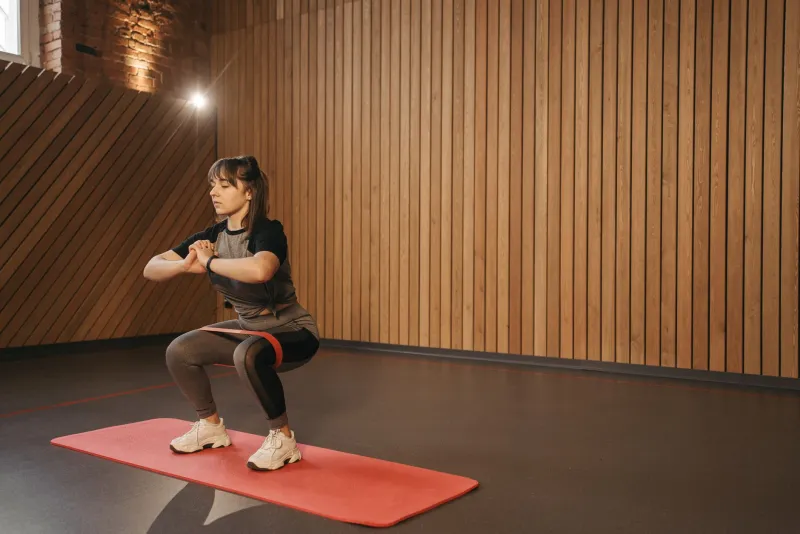
On a high-pain or low-energy day, the goal isn’t to prove you can push through. It’s to leave feeling like you’ve looked after yourself. That might mean:
- Swapping a barbell for dumbbells, or a standing exercise for a seated one.
- Shortening the session to 15 minutes and calling it done.
- Reducing range of motion rather than forcing a “full” rep.
- Using a belt, block, bench or wall for support.
- Choosing breathwork, gentle mobility or a short walk instead of lifting.
None of that is failure. It’s pacing. Endo is a condition that rewards consistency far more than heroics. A ten-minute session you can repeat next week beats a two-hour blitz that puts you in bed for three days. If pain is new, worsening, or you’re unsure what’s safe, check in with your GP, gynaecologist or a women’s health physio. Clinician-aware doesn’t mean clinician-dependent — it means you’ve got a sensible safety net.
Track What Actually Matters
If you’re tracking strength to prove your illness is real, stop. You don’t owe anyone a spreadsheet of suffering. Track markers that honour your actual life instead:
- Energy before and after — did the session drain you or steady you?
- Recovery time — how many hours or days until you feel back to baseline?
- Pain-free range — can you reach a bit further without flinching?
- Consistency — how many gentle sessions did you manage this month?
- Confidence — did you feel less like an imposter in the gym?
- Sleep and mood — are they nudging in the right direction?
These are real strength markers. They’re also kinder than chasing a number on a barbell that doesn’t know you have endometriosis.
Building a Quiet Kind of Confidence
Strength with endo isn’t always loud. Sometimes it’s walking into the gym knowing you’ll modify, and doing it anyway. Sometimes it’s saying “not today” without a paragraph of explanation. Sometimes it’s lifting a weight that looks modest on paper but represents a genuine win for your body.
You don’t need a visible badge to deserve a careful, strong, satisfying training life. You just need a plan that believes you — and the confidence to keep showing up at your own pace.