Your Steps Aren’t a Strength Program: Building Real Support for Feet-First Workdays

Photo: DFID - UK Department for International Development, CC BY 2.0, via Wikimedia Commons
Standing all day can feel like proof you’re strong. You’re on your feet for hours, moving between rooms, reaching, carrying, crouching, explaining, serving, lifting, soothing. By the end of a shift, your legs are heavy and your step count is respectable. So why does a simple strength session feel so far out of reach?
Because standing endurance is not the same as strength. And for anyone living with endometriosis, a feet-first job can quietly drain the very energy you need to build it.
This is for the teachers who spend parents’ evening in low heels, the nurses doing twelve-hour shifts, the retail staff who haven’t sat down since lunch, and the hospitality workers who are basically doing a step class with a tray. Your job is physical. That does not mean your body is getting a balanced strength programme from it.
Why standing all day doesn’t build the strength you think
Standing is a position. Strength is the ability to produce and control force. They overlap, but they are not the same.
A shift on your feet often means repeated small movements in a narrow range: walking, shifting weight, reaching, maybe standing with your hips tucked and your shoulders rounded. That can build endurance in some muscles while leaving others under-supported. It can also encourage compensation — your lower back doing the work your glutes and deep hip muscles could share, or your pelvic floor staying switched on because you’re bracing without realising it.
For endo bodies, that matters. Pelvic heaviness, lower back ache and fatigue can make you hold tension in your hips and jaw without noticing. By the time you finish work, you’re not “warmed up” for strength training. You’re already spent.
So the goal isn’t to add more standing. It’s to add support.
The endo twist: pelvic floor, lower back and fatigue
Endometriosis can make the pelvic floor overwork. Pain, fear of leaking, holding your breath while lifting, or simply getting through a long shift can all encourage a guarding pattern. If you’ve been told your pelvic floor is overactive or you feel a lot of heaviness by the end of the day, a women’s health physio can assess this properly. You don’t have to guess.
In the meantime, two ideas are worth keeping in mind. First, a pelvic floor that is constantly clenched is not necessarily a strong one — it may be tired and tight. Second, your lower back often takes the load when your hips and glutes are under-supported. Short, regular resets can help you interrupt that pattern before it becomes your whole evening.
Before your shift: a five-minute setup, not a workout
You don’t need a full warm-up at 6.45am. You need your body to know it has options.
Try this in the staff room, at home, or in the car park before you go in:
- Breathe out longer than you breathe in. Three or four slow rounds. Let your ribs move and your jaw soften. This is not about forcing relaxation; it’s about reminding your pelvic floor it can let go.
- Roll your ankles and shift your weight. Ten slow rocks side to side, then front to back. It sounds tiny. It helps your feet and hips share the load.
- Do a gentle chair sit-to-stand. Three to five reps, using the chair arms if you need to. Stand up as you breathe out, sit down with control. This wakes up your glutes without making you sweat.
- Set one pacing intention. Maybe it’s “I will sit for two minutes at break” or “I will not hold my breath when I lift that box.” One intention is enough.
During the shift: pacing that survives real workplaces
Pacing is not a luxury. It’s part of managing pain and fatigue.
If you can, change position every 20 to 30 minutes — even briefly. One foot up on a low step or box can take pressure off your lower back. If you’re in a classroom, use the moments when pupils are working independently to sit at a desk rather than perch. In retail, use the till or stockroom as a natural reset point. In hospitality, lean on the counter rather than locking your knees.
And please: use the toilet when you need to. Holding on for hours is not toughness. It’s extra pelvic floor work you didn’t ask for.
Supportive shoes make a bigger difference than most people admit. If your workplace allows trainers with good cushioning, use them. If not, consider an insole and save the less supportive shoes for shorter days. Hydration and a proper break matter too — not because you need to “optimise” your shift, but because your body is not a machine.
After your shift: a reset, not a second shift
When you get home, the temptation is either to collapse completely or to force a workout because you “should”. Neither is the only option.
Give yourself ten minutes of transition. Lie on your back with your legs up a wall or on a chair if that feels comfortable. Let your breath settle. Then try a slow glute bridge or two, or a gentle cat-cow if your back feels stiff. The aim is not to train. It’s to tell your body the shift is over.
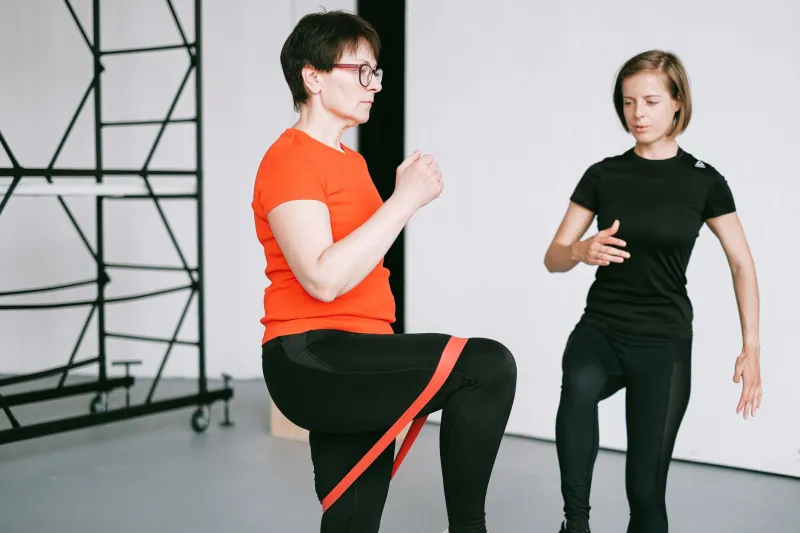
If you have energy left later in the week, that’s when a short strength session can fit — not straight after a twelve-hour shift. Two 15-to-20 minute sessions are plenty. Think squat, hinge, push, pull and carry. Use dumbbells, resistance bands or your own body weight. Keep the effort moderate. You’re building a base, not proving a point.
A realistic weekly shape
If you work long shifts, try to put strength sessions on your shorter days or days off. If your endo pain is high, swap the session for the pre-shift reset and a walk. That still counts as keeping the habit alive.
Remember that standing all day is a demand, not a programme. Real strength comes from supported movement, repeated gently, at your pace. Your feet-first job can coexist with that. It just needs a plan that respects the whole of your week — not just the hours you spend on the floor.
If pelvic heaviness, leaking, or lower back pain is persistent or getting worse, speak to your GP or ask about a referral to a women’s health physio. You deserve support, not just another pair of insoles.