Re-Entry, Not Restart: Your First Three Lifting Sessions After an Endo Gap
There is a particular kind of pressure that creeps in when you go back to the gym after time away. You know the one. You walk in with a vague plan, see someone else racking up plates, and suddenly your sensible little return session turns into a test you never agreed to sit.
If endometriosis has kept you out of strength training for weeks or months — because of a flare, fatigue, surgery, treatment, appointments, or just life doing its usual thing — you do not need a heroic restart. You need a re-entry. Something boring enough to repeat and kind enough to survive.
This is a three-session ramp for coming back after an endo gap. It is not a punishment for the time off. It is a way of reminding your body that lifting is allowed to feel steady again.
Why a re-entry plan beats a restart
A restart usually means trying to match your old numbers. A re-entry means finding your current baseline and working from there. Those are very different projects.
After time off, your muscles, tendons, joints and nervous system have all had a change of routine. Even if you kept walking or doing gentle movement, lifting is a specific skill. Your first sessions are not about building much. They are about checking in, greasing the movement patterns and leaving with something in the tank.
That last bit matters. If every return session leaves you wiped out for two days, you are not building confidence. You are building evidence that exercise is risky. We want the opposite: small, repeatable sessions that teach your body it can handle load without a flare-up tax.
Before session one: set your floor
Choose a starting load you could comfortably do five more reps with. That is your floor. It might feel almost silly. Good. The first session back is not the place to find your limit.
Pick two rest days between sessions, especially in the first week. Not because you are fragile, but because endo bodies often need a longer window to show you how they really feel about a session. A flare can arrive later than the usual soreness. Give yourself the space to notice.
Decide your exit criteria before you start. Mine would be: stop if pain climbs above your normal background level, if you feel light-headed, if bleeding becomes heavy or different for you, or if you are having to brace hard just to get through a set. You are allowed to leave mid-session. That is not failure; it is data.
Session one: find your baseline
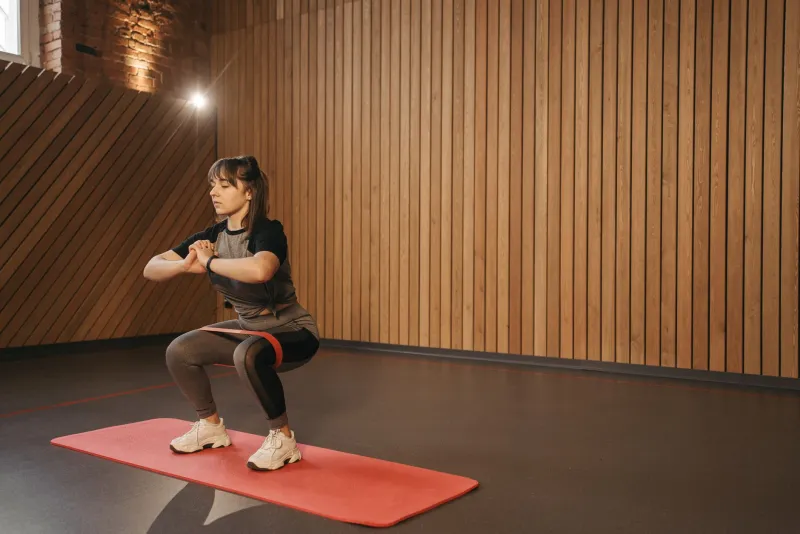
Warm up for eight to ten minutes. Not a token stretch by the lockers. Walk, cycle gently, do some hip circles, shoulder rolls and slow bodyweight squats to a chair. You want to feel warm and a bit more awake, not tired.
Then choose four movements: a sit-to-stand or box squat, a row, a hip hinge, and a press. Keep it that simple. Two sets of six to ten reps each, at a effort level of about 5 or 6 out of 10. No grinding. No holding your breath. No finishing a set and wondering if you will need a lie-down.
If you are in a gym, this is a good day to use machines or dumbbells rather than a barbell. If you are at home, a chair, a resistance band and a pair of light dumbbells are plenty. If you are working with NHS physio advice or a community exercise scheme, follow that guidance first — this plan is a general template, not a personal prescription.
Finish with five minutes of easy movement and a glass of water. Then go home. That is the whole session.
Session two: repeat, do not add
This is the session most people ruin. They feel okay after session one, so they add weight, add sets and add a new exercise. Then they wonder why the week falls apart.
Repeat session one almost exactly. Same movements, same loads, same sets. If the first session felt very easy, you can add one rep per set. That is it. The goal is to prove to yourself that the session is repeatable, not to chase a personal best.
Keep the rest day afterwards. Check in with your pain, bleeding, energy and sleep. If you had a mild flare that settled within a day, note it and keep the next session conservative. If the flare was bigger or lasted longer, drop back a step rather than pushing through.
Session three: a small, single progression
By session three, you are looking for a gentle nudge, not a leap. Choose one progression only: either add one set to two of the movements, or increase the load by around five to ten percent. Not both. Not every exercise. One change.
Keep the same exit criteria. Keep the rest days. Keep the warm-up. If you are using a leisure centre gym, pick a quiet time if you can, and ask for a quick induction if the equipment feels unfamiliar. If you are training at home, clear a space, put your phone on do-not-disturb and treat it like a proper appointment. If you are on an NHS waiting list for physio or pain support, you can still practise these low-load patterns while you wait — just keep them comfortable and stop if anything feels wrong.
The non-negotiables
Rest days are part of the programme, not a break from it. Sleep, food and hydration are not optional extras. If you are on your period, bleeding more than usual, recovering from a bug, or in a pain flare, you can repeat session one or simply walk instead. A gap does not have to become another gap just because you missed a planned session.
And please do not use soreness as a scorecard. Endo pain and training soreness can feel confusingly similar. If you are unsure, treat it as a sign to reduce rather than prove.
After the third session
If the three sessions went reasonably well, repeat that third session for another week before adding anything else. Slow progress is still progress. If pain, bleeding or fatigue got worse, speak to your GP, endometriosis specialist or physio. You have not failed the plan; the plan just needs adjusting.
Coming back after an endo gap is not about making up for lost time. It is about building a doorway you can walk through again and again. Three sessions, conservative loads, proper rest and a clear exit route. That is a return worth trusting.