The Induction Is Yours to Rewrite: A Gym Walkthrough Built for Endo Days
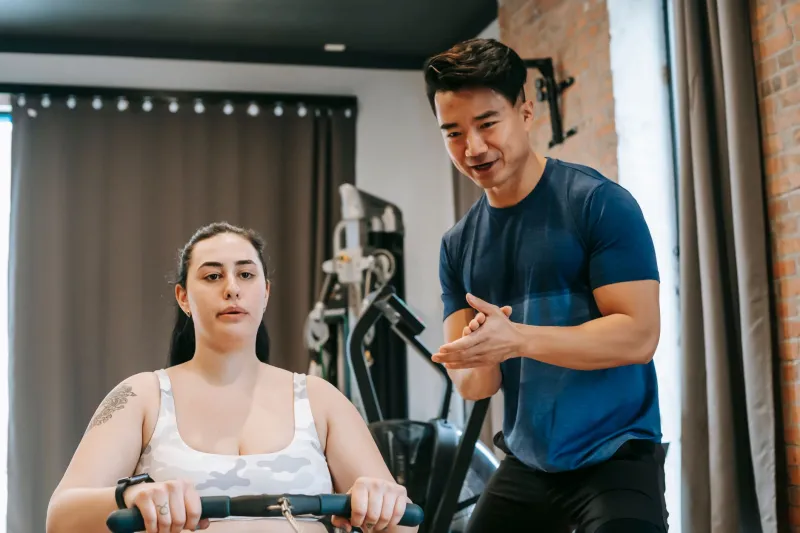
Gym inductions tend to follow a script: point at the cardio machines, wave at the weights, ask about goals, maybe add a token stretch. If your body has a habit of changing the plan halfway through, that tour can feel like being shown around a house you are not sure you can live in. The good news is that you can ask for a different induction. Not a fussy one. Not a medical appointment in trainers. Just an honest walkthrough that matches the body you actually have.
What an endo-aware induction should cover
A useful induction is not about memorising every machine. It is about reducing the number of unknowns before you next walk through the door. Ask the trainer to cover:
- Warm-up options that do not require getting down to the floor. A seated bike, a gentle cross-trainer, or simply walking a few laps may be more realistic on a tight, tired day.
- Machine setups that limit awkward transitions. Show me the leg press, seated row, and chest press rather than only free weights on a mat.
- Floor work alternatives. If you want to try mat work, ask what the options are when getting up and down feels like a lot.
- Toilets, changing rooms, water, and quiet seating. Not glamorous, but genuinely useful when pain or endometriosis belly arrives mid-session.
- The nearest exit and the least awkward way to leave. You should not have to explain yourself to a front desk while feeling awful.
- Quiet times. Ask when the gym is least busy, especially if you feel self-conscious or need more space.
- Their policy on freezing or pausing a membership. Flare days do not care about direct debits.
Before you sign: questions worth asking
You can ask these on the phone, by email, or at the desk. You do not need to justify every question with a diagnosis.
- Can I book an induction with a trainer who is comfortable talking about pain, fatigue, and changing plans?
- Can the induction be split across two shorter visits? A single 45-minute tour can be a lot when you are already managing symptoms.
- Can I bring notes or a support person?
- What is the process if I need to cancel or freeze my membership at short notice?
- Where are the accessible toilets and changing facilities?
- Is there a quiet area I can sit in if I need a pause?
If the answers feel evasive or the sales pitch keeps overriding your questions, that is useful information. A gym does not have to be perfect. It does need to be honest about what it can offer.
Floor work versus machines: pick the boring option if it helps
There is no rule that strength training has to happen on a mat with a barbell. Machines can be a practical choice when you want support, a predictable range of movement, and less getting up and down from the floor. Floor work can still be brilliant, but it is not a test of grit. Ask the trainer to show you both, then choose the version you are most likely to repeat on a low-energy Tuesday.
You also do not need to earn the right to use the machines. You are allowed to start with the seated row because it feels manageable, not because you have completed some invisible induction exam.
The exit route is part of the plan
This is the bit most inductions miss. Ask to be shown the nearest toilet, the quickest exit, and a place to sit that is not the middle of the free-weights zone. If you can, agree a simple line with the trainer: you may need to stop early, and you will not be offended if they do not follow you out. Knowing how to leave without a debrief is a genuine confidence boost.
Scripts that keep your details yours
You do not owe a gym your full medical history. You can describe what you need without naming your diagnosis.
For a leisure centre:
I am joining because I want to build strength, but I have a long-term condition that can flare without much warning. I do not need to go into the diagnosis. I would like an induction that covers adjustable machines, seated warm-up options, and what to do if I need to stop early. Could we book a quieter slot and split it into two shorter sessions?
For a private gym:
I am not asking for a medical plan. I am asking for a walkthrough I can actually use on a bad day. Please show me the exits, toilets, rest spots, and a couple of machine setups that do not require me to get up and down from the floor. I would also like to know how to freeze my membership if I am unwell.
Reasonable adjustments, without oversharing
Under the Equality Act 2010, organisations that provide services to the public, including gyms and leisure centres, have a duty not to discriminate and to make reasonable adjustments for disabled people. Endometriosis can count as a disability where it has a substantial and long-term impact on daily life. You do not have to use the word disability to ask for something practical.
Reasonable adjustments might mean a quieter induction slot, a trainer who understands that plans may change, a chair during the walkthrough, or clear information about pausing a membership. The gym may ask for some information, but it should keep it confidential and should not demand your entire medical file. If you feel nervous, put the request in an email so there is a record. This is not about demanding a spa day. It is about levelling the equipment.
After the induction: keep the first visit small
Your first solo session does not need to be a full workout. Go at a quiet time, warm up for five minutes, use two machines, and leave while you still feel okay. That is not a lack of ambition. It is data. You are learning how the gym fits around your body, not proving that your body can fit around the gym.
A good induction should make the room feel less like a test and more like a tool. You are allowed to rewrite the tour.