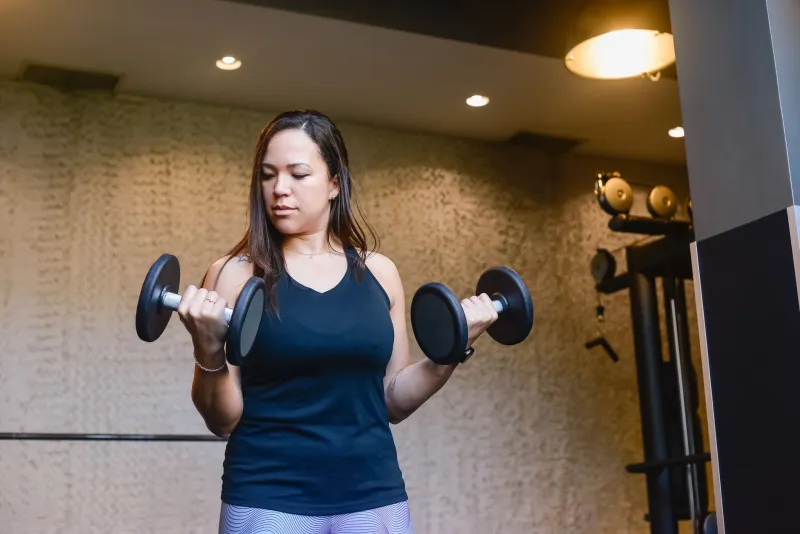
Party Season, Not Punishment Season: Strength Training With Endo This December
Photo: NA BRAIN, CC BY-SA 4.0, via Wikimedia Commons
December in the UK has a particular flavour: it is dark by mid-afternoon, the train carriage smells of mulled wine and wet coats, and your phone is full of invitations you feel vaguely guilty about. If you live with endometriosis, the festive season can feel less like a break and more like a month-long flare risk. Late nights, alcohol, rich food, travel, colder weather and disrupted routines all pile on top of a condition that does not take annual leave.
The good news? You do not need a perfect training plan to come out the other side feeling steady. You need a flexible one. This is not about smashing personal bests between the Christmas do and the Boxing Day walk. It is about keeping a thread of movement going so January does not feel like starting from scratch.
The December rule: keep a thread, not a plan
Most training plans assume life stays roughly the same shape for four weeks. December does not cooperate. So instead of aiming for three sessions a week and calling it a failure when the mince pies win, aim for a thread. That might be two short sessions, one walk, and a few movement snacks. It might be one 20-minute session in a quiet week and five minutes of stretching in a loud one.
A 12-minute session counts. A set of sit-to-stands while the kettle boils counts. Walking a lap of the platform because your train is delayed counts. The point is not to train optimally. The point is to remind your body that movement is still part of your week, even when your routine has been taken hostage by Secret Santa and a three-hour journey to your parents' house.
Build in buffer sessions before the chaos starts
Before December gets its grips into you, choose three possible slots in the week and treat them as buffer sessions. Not sacred. Not a test of your willpower. Just placeholders that can move if a Christmas do runs late or a flare turns up uninvited.
A buffer session can be 20 to 30 minutes and does not need to be fancy. Think: a few rounds of sit-to-stands, hip hinges with a kettlebell or a sturdy shopping bag, band rows, a carry across the room, and a dead bug. Keep it low-impact, keep it pain-free, and keep it short enough that you could realistically do it in a hotel room or a living room with the tree taking up half the floor.
If a session gets cancelled because you chose sleep, that is not a broken streak. That is the buffer doing its job.
Flare-aware boundaries for the social season
Endometriosis does not need you to be antisocial. It does need you to be honest about your limits. That might mean arriving late and leaving early. It might mean sitting down instead of standing in a crowded bar. It might mean swapping the second mulled wine for something softer, or saying no to the Boxing Day pub crawl because you already know how your pelvis will feel on the 27th.
Keep a small flare kit in your bag: pain relief you know works for you, a heat patch, spare pants, and anything else that makes a long day more manageable. Wear the shoes that let you walk without wincing. Book the seat on the train. Tell one person at the party that you might need to disappear for ten minutes. None of this is dramatic. It is just planning.
Travel-friendly movement that does not look like a workout
Travel is its own trigger: sitting for hours, carrying bags, sleeping in a different bed, eating at different times. You do not need a gym to keep things moving. At a service station, walk a couple of laps before you get back in the car. On a train, do gentle ankle circles and calf raises under the table. In a hotel room, use the wall for press-ups, the bed for glute bridges, and your own bodyweight for slow squats.
At a family house, the kitchen counter is your friend. Hold it for supported calf raises while the kettle boils. Do a few wall press-ups while you wait for the toast. Take a five-minute walk after dinner, even if it is just to the end of the road and back. These tiny sets are not a consolation prize. They are strength training in real life.
A short session menu for low-energy days
When your energy is low, decision-making is the first thing to go. So borrow this simple menu.
- The 15-minute reset: five sit-to-stands, five hip hinges, five band rows, five dead bugs. Two rounds. Stop while you still feel okay.
- The 25-minute strength session: three rounds of a lower-body move, an upper-body pull, a carry, and a core exercise. Rest as long as you need. Keep the range comfortable.
- The five-minute pain-day move: gentle cat-cow, pelvic tilts, shoulder rolls, and a slow walk around the room. No pressure to make it a workout.
If you are post-op, under a physio, or recently diagnosed, follow the guidance you have been given. If pain is sharp, new, or getting worse, stop and seek advice. Heavy bleeding, fever, fainting, or pain that does not settle are not things to train through. Contact your GP, NHS 111, or your specialist team.
Permission to scale back without losing momentum
Missing a week does not reset your strength. Your body is not a house of cards. You will not undo months of work because you spent three days eating cheese and watching films. The most useful thing you can do in December is keep the door open, even if you only walk through it for five minutes.
So scale back. Do the short version. Swap the gym for the stairs. Choose the earlier train. Say no to the extra event. And when you do train, notice that you showed up. That is momentum. That is the thread. January is not a restart because you never actually stopped.
At EndoLifter, we are not here to sell you a perfect December. We are here to help you move, manage pain, and build strength at your pace, even when your pace is slower than the Christmas market crowd.