Lifting Through the Hormone Handover: Strength Training When Endo Meets Perimenopause
You've spent years learning your endometriosis patterns. You know the warning signs, the flare timings, the tricks that take the edge off. Then perimenopause arrives and redraws the map. Pain that used to arrive like clockwork now turns up mid-cycle. Sleep goes sideways. Your knees feel creaky in a way that's new. Bleeding becomes anyone's guess. It's not you losing the plot — it's two hormonal stories overlapping, and they don't always tell a coherent tale.
When Your Body Sends Two Sets of Signals
Perimenopause is the transition towards menopause, and it often begins in your mid-40s (though it can start earlier). Oestrogen levels swing up and down rather than declining in a neat line. Because endometriosis is sensitive to oestrogen, those fluctuations can change how your endo behaves. Some people find their pain improves. Others find it worsens or becomes less predictable. Bloating, fatigue, joint stiffness and sleep disruption are common in both perimenopause and endo, which makes it genuinely hard to know which symptom belongs to which condition.
That overlap can feel unsettling. You're not imagining it, and you're not being dramatic. It's a recognised clinical grey area, and it's one reason why keeping notes and talking openly to your GP or endometriosis specialist matters.
Why Strength Training Still Earns Its Place
Bone density drops more quickly during perimenopause, and muscle mass naturally declines with age. Strength training is one of the most effective things you can do to counter both. It also supports joint stability, helps with mood, and can improve sleep quality over time. None of that means you should ignore symptoms or push through pain. It means strength work is still a worthy investment — just one that needs a flexible plan.
The goal shifts from chasing personal bests to building a resilient baseline. Think "what can I do consistently?" rather than "what can I do on my best day?"
Pace Like You Mean It
Use rate of perceived exertion (RPE) rather than fixed weights. Aim to finish most sets feeling like you had three or four reps left in the tank. On days when your joints ache or sleep was rubbish, drop the load by 20–30% and keep the movements. Shorten sessions. Two focused 20-minute sessions will serve you better than one 60-minute crash-and-burn.
Try a simple traffic-light system: green days mean you feel steady and can train at a moderate effort; amber days mean lighter loads, extra warm-up, maybe fewer sets; red days mean mobility, breathing and a walk — no guilt. This isn't a failure of discipline. It's good programming for a body that's navigating two hormonal shifts at once.
Recovery Is Not Optional
Perimenopause can make sleep more fragile, and poor sleep ramps up pain sensitivity. Protect your recovery like it's part of the workout. Keep bed and wake times as consistent as you can. Eat protein at each meal to support muscle repair. Drink enough water. Take rest days without negotiating. If you've had a run of bad nights, reduce your training load before your body forces the issue.
Track Symptoms Without Becoming a Spreadsheet
A simple log can be genuinely illuminating. Note the date, bleeding pattern, pain score (0–10), sleep quality, joint symptoms, energy levels and what training you did. After four to six weeks, look for patterns — not daily. You're not aiming for perfect data; you're aiming for enough information to spot whether certain sessions or phases leave you worse off. Bring those notes to appointments. It helps your GP or specialist see the bigger picture in a ten-minute slot.
When to Book the GP or Your Specialist
Some symptoms deserve a proper conversation rather than a wait-and-see approach. Book an appointment if you notice new or unusually heavy bleeding, bleeding between periods or after sex, pain that no longer responds to your usual pain relief, new joint pain or swelling, or mood changes that feel overwhelming. Hot flushes and sleep disruption that affect daily life are also worth discussing.
If you're considering HRT, talk it through with someone who understands endometriosis. Some progestogens are used to manage endo, and the balance of oestrogen and progestogen matters. There's no one-size-fits-all answer, and it's okay to ask for a referral to an endometriosis specialist centre if you feel your GP is unsure. Also ask about bone health if you have risk factors such as early menopause, long-term steroid use or a family history of osteoporosis.
A Session That Bends With You
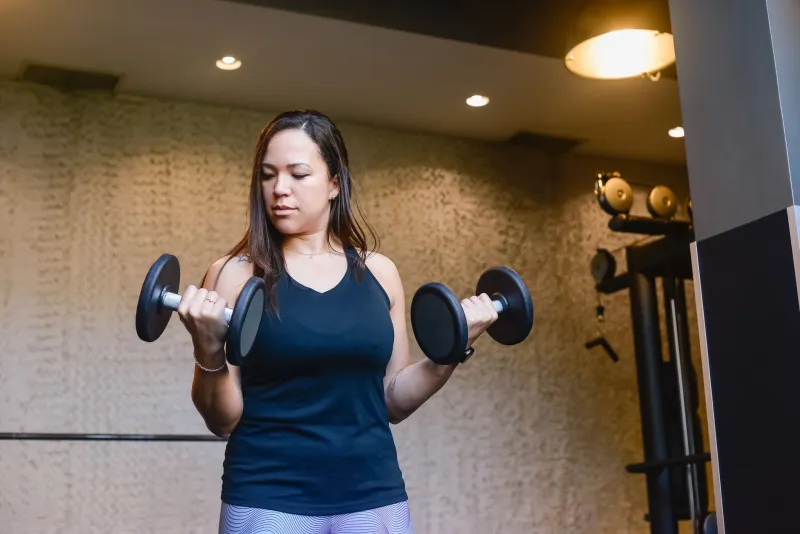
Warm up for five minutes: marching on the spot, arm circles, hip circles, gentle bodyweight squats. For the main block, choose two or three movements: a goblet squat or sit-to-stand, a row or band pull-apart, a glute bridge, and a suitcase carry. Do two to three sets of 8–12 reps at an RPE of 6–7. Finish with mobility — cat-cow, a hip flexor stretch, and some slow breathing. If your joints are grumpy, reduce the range of motion rather than skipping the movement entirely.
The Takeaway
You're not starting over. You're adapting. Strength training during perimenopause with endo is a conversation with your body, not a command. Some weeks will feel like progress; others will feel like survival. Both are valid. The plot twist isn't the end of the story — it's just a new chapter, and you get to write it at your own pace.