After the Shift, Not Before It: Building Strength When Your Job Already Spends Your Body

Photo: Roxanne Brabant, CC BY-SA 2.0, via Wikimedia Commons
There's a particular flavour of unhelpful advice that lands on anyone with a physical job. You've done a twelve-hour shift, hoisted more weight than a gym-goer on leg day, and someone cheerfully suggests you "just get your steps in" or "try a quick workout before work". Meanwhile your hip is throbbing, your lower back has opinions, and your idea of self-care is sitting down in silence for twenty minutes.
If that's you, this one's for you. Not because you need to try harder, but because you deserve a strength plan that counts what you already do.
Your shift is already a session
Nursing, caring, teaching, retail, cleaning, hospitality, warehouse work, hairdressing, kitchen shifts — these are physically demanding jobs dressed up as ordinary ones. You squat, hinge, twist, reach, carry, stand and hold tension for hours. You also do a lot of emotional labour, which is its own kind of load and quietly expensive.
None of that needs to be converted into calories or steps to count. It counts because your muscles, joints and nervous system have already been worked. A sensible strength plan starts by asking a different question: not "how do I fit exercise in?", but "what's the smallest useful thing I can add on top of this?".
The rule of two hard things
You can't stack every hard thing on the same day and expect a body with endometriosis to absorb it cheerfully. A useful guardrail is to allow yourself one hard thing per day — and a shift of any real length counts as one.
- Long shift day? That's your hard thing. Strength is a bonus, not a requirement.
- Short shift or admin day? A 25-minute strength session fits.
- Day off after three shifts? Treat it as recovery until proven otherwise. Walk, stretch, sleep.
- Flare day? Nothing is owed. Flare care is the work.
If you're honest about which days are already loaded, you stop writing plans you were never going to follow — and stop feeling like a failure when you don't.
What to actually do: the minimum effective dose
Two short sessions a week is a genuinely respectable starting point for someone whose job is already active. Twenty-five to thirty minutes, full body, nothing fancy.
A simple structure:
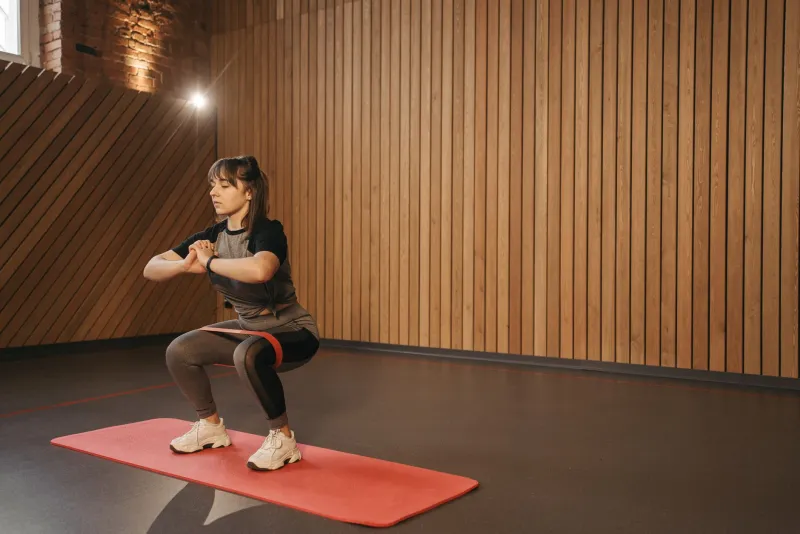
- A hinge — hip bridge, Romanian deadlift with dumbbells, or a kettlebell deadlift.
- A sit-to-stand or box squat — the same pattern you use every time you get up from a patient's bed or a low shelf.
- A push — press-ups against a counter, or a dumbbell overhead press.
- A pull — a band row, or a cable row at the gym.
- A carry — farmer's carries with two bags of shopping, or a single heavy bag held at your side.
The carry is the one people skip and it's the one that pays you back at work. Rows and carries build the upper back and grip that stop your shoulders creeping up around your ears by hour nine.
Aim for a effort level where you could do three or four more reps than you actually did. You are not trying to leave the session wrecked. You're trying to leave it able to do tomorrow.
Program by shift, not by week
Calendars are a lie when you're on a rota. Instead of drafting a perfect Monday–Friday plan you'll abandon by Thursday, anchor your sessions to your days off and short shifts, and let the rest fall where they fall.
- After a night shift: no lifting. Sleep, eat something with protein, walk if it feels good. That's it.
- Before a long shift: nothing strenuous. A ten-minute mobility or band session is plenty.
- On a split shift or a short day: this is your window. Take it.
- When the week collapses entirely: do one ten-minute "microdose" — a set of sit-to-stands, a set of rows, a carry up and down the hall. Something is not nothing.
Rotas with no pattern are the hardest. On those weeks, keep the bar laughably low and treat any session as a bonus rather than a baseline. Consistency over months beats intensity over days.
Job fatigue or a flare brewing?
The tricky bit is telling the difference between "I've been on my feet for nine hours" and "something is starting". They can feel similar at 6pm on a Tuesday.
Usually job fatigue:
- Heaviness in the legs, achy feet, a foggy head
- Improves after food, a shower, sitting down, or a night's sleep
- Fairly symmetrical, and predictable after a long shift
- No new pain, just tiredness in the places you'd expect
Worth treating as a flare:
- Pain that climbs steadily rather than easing, or moves somewhere new
- A change in the quality of the pain — sharper, burning, cramping
- Bloating or swelling that wasn't there this morning
- Nausea, dizziness, or feeling fluey
- Any change to bleeding that's unusual for you
- Pain passing urine or opening your bowels, or pain that's worse with either
If it's the second list, stop training and switch into flare-up care. If you get chest pain, sudden breathlessness, a swollen hot calf, or a fever you can't explain, that's not a training decision — call 111 or 999 as appropriate.
Recovery is part of the job description
You can't out-supplement a life spent on your feet. The basics do more than any gadget: sleep where you can get it, protein at most meals, water within reach, and shoes that are actually supportive rather than merely acceptable. Compression socks are unglamorous and genuinely helpful on standing shifts. Anti-fatigue mats exist and you're allowed to ask for one.
Take your breaks. Sit down. Not at your desk with a clipboard, but properly down. If you're entitled to reasonable adjustments at work — and endometriosis can be treated as a disability under the Equality Act 2010, depending on how it affects you — that's a conversation with Occupational Health worth having. Lifting equipment, shift swaps and a place to rest during a flare are not favours.
A shift-adjusted week that looks like real life
- Monday: long shift (hard thing done)
- Tuesday: 25-minute full-body session, moderate effort
- Wednesday: shift, plus a ten-minute walk after
- Thursday: day off — rest, mobility, food, sleep
- Friday: 25-minute session, slightly heavier carries
- Saturday: shift
- Sunday: rest or a gentle walk
If a session doesn't happen, cross it out and move on. The plan serves you, not the other way around.
Strength that gives back
Your body is not a project that's behind schedule. It's already doing a demanding job, often while managing pain that most people around you can't see. The point of adding strength work isn't to prove you can do more — it's to make the shifts feel a little less like borrowing from tomorrow.
Start small. Count what you already carry. Build from there.