Low Battery, Not Low Ambition: Training Through Suspected Low Iron
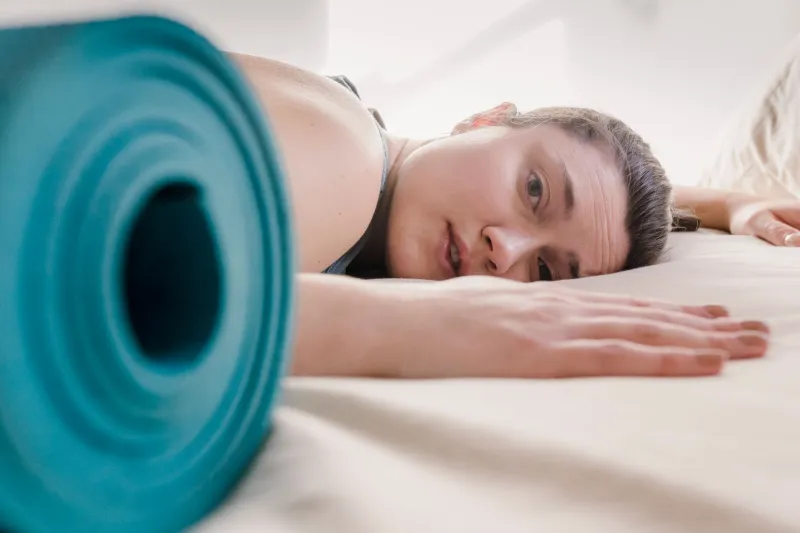
There's a specific kind of tired that comes with heavy periods. Not the pleasant, earned tired of a long walk. More the kind where you stand at the bottom of the stairs and quietly calculate whether you actually need to go up them.
If that sounds familiar, and you're also trying to keep some strength training going, this one's for you. Because there's a real difference between a session that's hard work and a session your body genuinely doesn't have the raw materials for.
The tiredness that a nap doesn't fix
Iron does the heavy lifting of carrying oxygen around your body. When your stores run low, everything that needs oxygen gets slower — your legs on a walk, your brain mid-afternoon, your recovery between sets. Heavy menstrual bleeding is one of the most common causes of iron deficiency in the UK, and endometriosis and heavy bleeding often travel together.
So if your training has quietly fallen apart over a few months — same weights, suddenly impossible; same walk, suddenly hilly — that's not a character flaw. That's data.
Signs worth writing down
You don't need every one of these, and none of them prove anything on their own. But a pattern is worth capturing in your phone notes:
- Breathless on stairs or on the walk you used to do easily
- A racing or thumping feeling in your chest after small effort
- Dizziness when you stand up
- Unusual pallor, or people commenting that you look washed out
- Hair shedding more than usual
- Cold hands and feet when everyone else is fine
- Restless legs at night
- Craving ice, or chewing it without really thinking
- Brain fog that feels different from endo-fog
- Periods that flood, clot heavily, or last more than seven days
Write down your actual bleeding pattern too — how many days, how often you change protection, whether you're passing clots. It's the kind of detail that turns "I'm tired" into a concrete clinical clue.
Why "just push through" tends to backfire
Here's the thing about training through genuinely low iron: it doesn't build you a reserve. It spends one you don't have. You'll likely see a higher perceived effort, slower recovery, worse sleep and — frustratingly — a higher chance of niggles, because tired tissue moves badly.
There's also a subtler cost. When you force sessions that leave you flattened for two days, you start associating movement with depletion. That's a hard association to unpick later.
What to ask for at your GP surgery
Book an appointment and be direct. Something like: "I have heavy periods and I'm exhausted in a way that's affecting daily life. Could we check my iron?" In the UK, that usually means a full blood count (which shows haemoglobin and how your red cells look) plus a ferritin test for your iron stores. It's reasonable to also ask about B12 and folate, and about whether inflammation could be skewing your ferritin result — ferritin rises with inflammation, which can make low stores look normal.
Two practical notes. First, timing matters: iron levels shift around your period, so mention where you are in your cycle if you know. Second, if your results come back "normal" but you feel awful, it's okay to ask whether iron deficiency without anaemia is a possibility, and to ask for a repeat in a few months if symptoms continue.
While you're there, heavy bleeding itself is treatable. It's worth asking what options exist for managing the bleeding — that's a conversation to have with your GP, not something to solve from a blog post. But do have it.
Scaling the session, not scrapping it
You don't need to stop moving. You do need to stop treating every week like a build phase.
- Halve the volume before you touch the weight. Two sets instead of four. One session instead of three.
- Leave more in the tank. Aim to finish each set feeling like you had three or four reps left, not zero.
- Keep the big movements, cut the extras. A squat, a hinge, a push, a pull. That's a session.
- Bin the intervals for now. Hard cardio when you're breathless at rest is a poor trade. Walking, swimming or gentle cycling are friendlier choices.
- Take the rest day before you think you need it. Two days between sessions is not laziness, it's mathematics.
- Sit down between sets. Actually sit. Ninety seconds minimum, longer if you're wiped.
If you're tracking anything, track how you feel the day after a session rather than the numbers on the bar. That's the honest measure right now.
Fuel and the boring stuff
Iron from food comes in two forms, and the one from meat, fish and poultry is absorbed more readily. Plant sources — lentils, beans, tofu, fortified cereals, dark leafy greens, dried apricots — still count, especially paired with something containing vitamin C (a squeeze of lemon, a pepper, a glass of orange juice with the meal). Tea and coffee at mealtimes reduce absorption, so try leaving a gap either side.
Don't start high-dose iron supplements off your own bat. Iron is one of those things where too much is genuinely unhelpful, and the dose depends on your results — that's a conversation for your GP or pharmacist.
While you wait for answers
The waiting is often the hardest part. In the meantime, lower the bar rather than clearing it entirely. A ten-minute walk, a couple of easy sets of sit-to-stands, a stretch before bed. Small doses keep the habit alive without borrowing energy you don't have.
And get urgent help — NHS 111 or 999 depending on severity — if you have chest pain, severe breathlessness at rest, a racing heart that won't settle, or bleeding so heavy you're soaking through protection in under an hour.
One last thing. If your training has stalled and you're exhausted, you are not undisciplined, and you haven't "lost your motivation." You might just be running a body on a low tank. That's worth investigating kindly, not training through.